Die Semantische Intuition ist eine Ideenfindungsmethode, die für bestimmte Anwendungsfälle sehr wirksam ist. Man kann sie sehr präzise auf die Aufgabenstellung zuschneiden, und sie macht den Workshop-Teilnehmern zudem auch Spaß. In diesem Beitrag zeigen wie ein konkretes Beispiel für die Anwendung der Methode aus einem Kundenprojekt.
Die Semantische Intuition
Für die Methode werden zwei (oder manchmal drei) Wortlisten benötigt, die sich auf unterschiedliche Aspekte der Aufgabenstellung beziehen. Um Inspiration zu bekommen, wählt man ein beliebiges Wort aus jeder Liste und setzt sie zu einem Begriff zusammen. Das macht man im schnellen Wechsel, bis eine Kombination eine Idee anregt.
Die Ideenfindungsaufgabe
Unser Auftraggeber war ein weltweit tätiger Konzern im Anlagenbau. Die Aufgabe lautete, Ideen für neue Produkte und Systeme für die Prozessautomatisierung zu entwickeln. Im Idealfall sollten die Ideen zu Erfindungen führen, die sich patentieren ließen. Am Workshop nahmen zwölf Ingenieure und Physiker einer Entwicklungsabteilung teil. Der Workshop dauerte eineinhalb Tage, davon etwa eine Stunde mit der Semantischen Intuition.
Unsere Vorbereitungen
Wir haben uns im Vorfeld zum Workshop mit dem Abteilungsleiter und ein paar Ingenieuren unterhalten, um ein Verständnis für die Aufgabenstellung und einen Einblick in die fachspezifischen Details der Prozessautomatisierung zu gewinnen. Dieser Schritt ist sowohl für die Gestaltung der Ideenfindungsmethoden als auch für die Bewertung der Ideen von großer Bedeutung.
Wir haben uns für die Semantische Intuition als eine der Ideenfindungsmethoden entschieden, weil sich die Aufgabe durch viele anwendungsspezifische Fachwörter beschreiben ließ. Wir haben uns für drei Begriffslisten entschieden, was ungewöhnlich ist: meistens setzen wir nur zwei Listen ein.
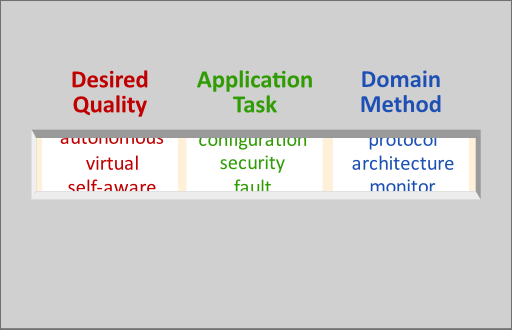
Mit Hilfe unserer Recherchen haben wir die Dimensionen Desired Quality, Application Task und Domain Method gewählt. (Der Workshop wurde auf englisch durchgeführt). Die Dimension Desired Quality enthält diverse wünschenswerte Eigenschaften einer Prozesssteuerung. Die Dimension Application Task beschrieb unterschiedliche Funktionen und Aspekte der Systeme, und Domain Method war eine Sammlung von typischen Elementen, die in großen technischen Systemen vorkommen.
Die Beispielanregungen
Wir haben für jede Dimension zwanzig Einzelanregungen gewählt, die zum Teil aus unserer eigenen Erfahrung und zum Teil aus unseren Gesprächen mit den Experten stammten. Wir haben jede Liste auf einem langen Papierstreifen gedruckt, sodass die Workshop-Teilnehmer sie wie im Titelbild gegeneinander verschieben konnten, um immer wieder neue Kombinationen zu bilden.
Desired Quality
Application Task
Domain Method
1
adaptive
change
alert
2
autonomous
compromise
algorithm
3
context-aware
configuration
architecture
4
distributed
coordination
broker
5
general-purpose
correction
capability
6
incremental
decision
code
7
learning
defect
controller
8
local
exception
detection
9
migratable
fault
device
10
multi-purpose
health
hierarchy
11
peer-to-peer
objective
language
12
proactive
optimization
manager
13
run-time
performance
message
14
self-aware
problem
model
15
self-correcting
product
monitor
16
situation-dependent
replacement
negotiation
17
smart
security
policy
18
standardized
status
protocol
19
unsupervised
test
request
20
virtual
update
vector
Das führte im Laufe der Stunde zu Hunderten von Inspirationen wie virtual security architecture oder distributed performance protocol.
Das Ergebnis
Unsere Teilnehmer haben mehr als Hundert Kombinationen betrachtet. Die meisten von ihnen führten zu keinem Ergebnis, was aber ganz normal ist bei dieser Methode. Für einen Auftrag dieser Art, wo es um große Industrieanlagen geht, genügt es, wenn nur eine Handvoll vielversprechende Ideen entstehen, weil schon eine einzige gute Idee die Attraktivität eines sehr teuren Produktes steigern und die Marktposition des Unternehmens stärken kann.
Darüber hinaus hatten die Workshop-Teilnehmer viel Spaß mit der Methode, und einige von ihnen haben uns gebeten, nach dem Workshop die Papierstreifen mitnehmen zu dürfen (was natürlich kein Problem war).
Kommentar
Die Semantische Intuition kommt nicht für jede Ideenfindungsaufgabe in Frage, aber dort, wo sie sich eignet, kann sie sehr ergiebig sein. Dieses Beispiel zeigt, dass die Vorbereitung der Mmethode detaillierte Kenntnisse der Aufgabenstellung und damit eine intensive Auseinandersetzung mit dem Thema voraussetzt.
Eine gute Moderation ist für die erfolgreiche Zusammenarbeit entscheidend. Das ist bei Innovationsworkshops besonders kritisch – nicht nur, weil der Workshop teuer ist, sondern auch, weil viel auf dem Spiel steht. Wir präsentieren ein paar Erfahrungen aus der Moderation von Innovationsworkshops und geben ein paar Tipps für den Innovationsmanager.
Teamarbeit
Ein Workshop wechselt zwischen Phasen der Teamarbeit und Phasen, in denen die ganze Gruppe zusammen ist. Die Arbeit in Fünf-Personen-Teams hat mehrere Vorteile:
Fünf Personen sind genug, um sich gegenseitig zu befruchten.
Ein Moderator kann das Gespräch mit fünf Personen gut lenken.
Jede Gruppe sitzt an einem eigenen Tisch und kann unabhängig von den anderen arbeiten.
Durch den räumlichen Abstand zu den anderen Gruppen ist die Lautstärke im Raum vertretbar, und die Teilnehmer können das Gespräch am eigenen Tisch gut verfolgen.
Die Produktivität ist höher: Drei Teams von fünf Personen erzeugen drei mal so viele Ideen wie eine Gruppe von 15 Personen.
Das bedeutet zum Beispiel, dass für einen Workshop mit 15 Personen drei Moderatoren benötigt werden. Dieser Aufwand lohnt sich aber wegen der deutlich höheren Produktivität, die dadurch ermöglicht wird.
Bei einem Online-Workshop werden die Team-Tische durch Breakout-Rooms in der Kommunikationssoftware simuliert, in denen die Teams ungestört arbeiten können.
Moderatoren
Nach unserer Erfahrung ist das optimale Verhältnis von Moderatoren zu Teilnehmern 1 zu 5. Damit hat jeder Arbeitstisch einen eigenen Moderator, der das Gespräch dort leitet. Einer dieser Moderatoren ist zugleich der Hauptmoderator, der die gemeinsamen Phasen wie beispielsweise die Abschlussdiskussion leitet. Normalerweise ist der Hauptmoderator Autor des Workshop-Drehbuchs und hat die tiefsten Kenntnisse über die Hintergründe zum Auftrag und über das Workshop-Ziel. Für die anderen Moderatoren ist ein ausführliches Workshop-Drehbuch in der Regel ausreichend.
Bei einem Online-Workshop reicht neben dem Hauptmoderator ein Moderationsassistent.
Der Workshop-Raum
Idealer Raumaufbau für 15 Teilnehmer
Der ideale Raum für einen Workshop ist groß genug, um die ganze Gruppe zweimal aufzunehmen. Im vorderen Bereich kann die Gruppe zusammen sitzen, am besten in der U-Form. Hier finden die gemeinsamen Aktivitäten wie die Begrüßung, die Aufwärmspiele und die Abschlussdiskussion statt. Im hinteren Bereich sitzen die Teilnehmer in der Bankettbestuhlung – das heißt jeweils zu fünft mit einem Moderator an einem Tisch. Hier findet die Kernarbeit wie die Ideenfindung und die Ideenbewertung statt. Im Idealfall ist der Raum hell, mit einer hohen Decke und vielen Fenstern, denn ein dunkler, beengter Raum engt auch das Denken ein.
Tipp im Umgang mit Hotels
Hotels werben teilweise mit absurden Kapazitäten für ihre Meeting-Räume. Bei einem Kundenprojekt beispielsweise wollte ein Hotel in einem 80qm-Raum 50 Personen in der Bankettbestuhlung unterbringen. Dies entspricht nur 1.6 qm pro Person. In einem anderen Fall behauptete ein Pariser Business-Hotel sogar, es könnte im 80 qm-Raum sogar 100 Personen (0.8 qm pro Person) unterbringen. Solche Personendichten schaffen eine Atmosphäre, die eher zu einer Sardinenbüchse passt als zu kreativer Gruppenarbeit, und eine effektive Arbeit ist nicht möglich.
Für eine bequeme Moderation von Innovationsworkshops rechnen wir ungefähr 10 qm pro Person. Erst bei dieser Raumgröße haben wir genug Platz, um die verschiedenen Arbeitsbereiche unterzubringen und gleichzeitig das notwendige Raumgefühl zu bewahren. Allein eine Pinnwand, die beidseitig verwendet wird, belegt schon mehr als 5 qm, und in einem ergiebigen Workshop produziert jeder Teilnehmer genug Rohideen, um eine Pinnwandseite zu füllen. Die Forderung nach 10 qm pro Person löst staunen und bisweilen auch Widerstand bei den Hotels aus, ist aber dennoch unserer Meinung nach für eine gutes Arbeitsergebnis unentbehrlich.
Das Workshop-Umfeld
Besprechnungsräume im Unternehmen (und Seminarräume in vielen Hotels!) wirken meisten farblos, steril und wenig inspirierend. Es ist für die Kreativität sehr förderlich, wenn der Workshop außerhalb der gewohnten vier Bürowände an einem schönen oder ungewöhnlichen Ort stattfindet. Das hilft den Teilnehmern, sich gedanklich von ihrem Tagesgeschäft zu befreien und so leichter auf neue Ideen zu kommen.
Es gelingt manchen Hotels, dieses Ambiente zu schaffen. Der Schindlerhof in Nürnberg gefällt uns ausgesprochen gut. Leider bieten viele Hotels nur steril wirkende Räume, die für die kreative Arbeit eher hinderlich sind. Wir raten von solchen Hotels ab – da kann man genauso gut im firmeneigenen Besprechungsraum bleiben.
Innovationsworkshop im Fußballstadion
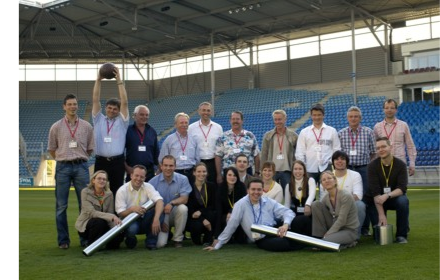
Exotische und ungewöhnliche Orte sind eine interessante Alternative zu einem Seminarhotel. Wir haben die Erfahrung gemacht, dass sie die Stimmung der Teilnehmer positiv beeinflussen. Wir nehmen diese Alternative sehr gern und haben Workshops an sehr unterschiedlichen Orten durchgeführt. Bei uns in Magdeburg beispielsweise eignet sich der VIP-Bereich des Fußballstadions sehr gut.
Nachteil solcher Orte ist allerdings, dass man unter Umständen Pinnwände und anderes Workshop-Material selbst mitbringen muss.
Spiele und Spielzeug
Paarfindung für ein Aufwärmspiel
Spiele helfen, die Energiepegel in der Gruppe zu heben (vor allem nach dem Mittagessen!) und eine positive Stimmung zu schaffen. Wir haben viele solche Spiele getestet; am häufigsten kommen unsere vier Lieblings-Aufwärmspiele zum Einsatz.
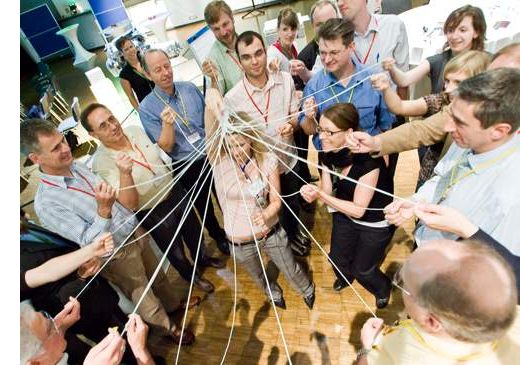
Manche Spiele brauchen Material oder Requisiten. Diese kosten aber nur ein paar Euro und können immer wieder verwendet werden. Wir haben zum Beispiel für die Pausen immer Jonglierbälle dabei, und wir stellen immer Bastel-Sets wie Holzklötzchen oder Lego auf die Team-Tische, weil Ingenieure und Techniker gern damit spielen. Etwa zwei Meter lange Polyesterseile aus dem Baumarkt kann man für viele Zwecke einsetzen. Im Bild benutzen wir sie, um zufällige Paare für ein Aufwärmspiel zu bilden.
Spezialanforderungen im Innovationsprozess
Alles, was wir hier beschrieben haben, könnte für jede Art von Workshop gelten. Die Moderation von Innovationsworkshops bringt aber eine Reihe zusätzlicher Anforderungen mit. Diese sind für den Moderator wichtig, der sich auf diesen Anwendungsbereich spezialisiert hat. Dazu gehören…:
Die Fähigkeit, sich in die fachlichen Einzelheiten jedes Auftrages einarbeiten zu können. Dazu gehören typischerweise technische Details des betreffenden Produktes oder der betreffenden Anwendung.
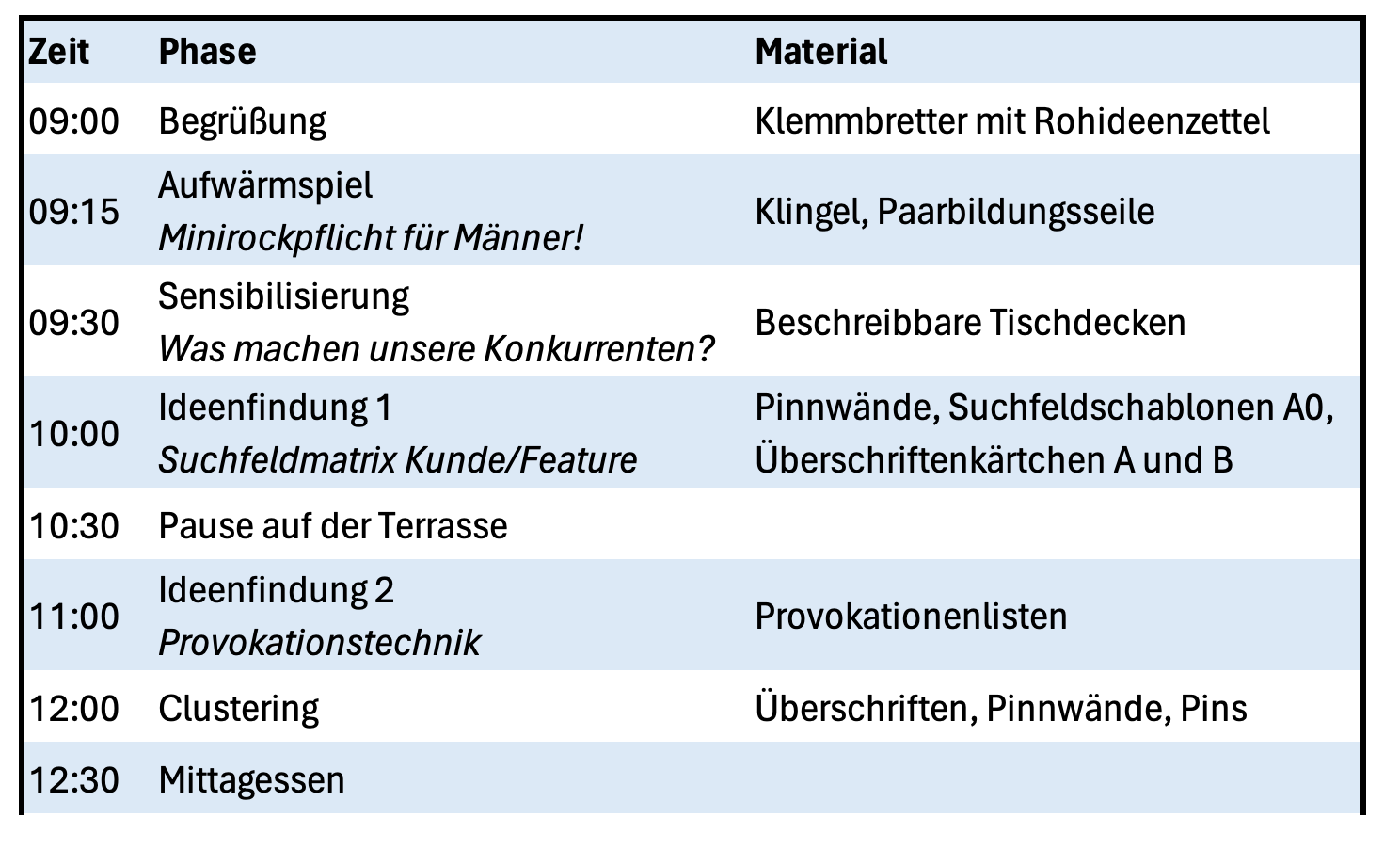
Die Fähigkeit, Ideenfindungsmethoden und Bewertungskriterien zu gestalten, die auf die jeweilige Aufgabenstellung zugeschnitten sind. Hier ist ein Beispiel, wo wir die Provokationstechnik für die Verbesserung eines Gerätes verwendet haben.
Für den Innovationsmanager, der die Workshops in seinem Innovationsprozess selbst moderiert, sind diese Anforderungen selbstverständlich. Es ist aber leicht, den Aufwand in der Vorbereitung zu unterschätzen.
Links zu ausgewählten Beiträgen in dieser Kategorie
Um im Wettbewerb zu überleben, brauchen Unternehmen Innovationen. Das bedeutet, dass sie früher oder später einen Innovationsprozess einrichten müssen. Dieser Prozess kann bei einem kleinen Unternehmen einfach und informell sein; dagegen ist er bei großen mittelständischen Unternehmen und Konzernen strukturiert und wird von einem Innovationsmanager verantwortet.
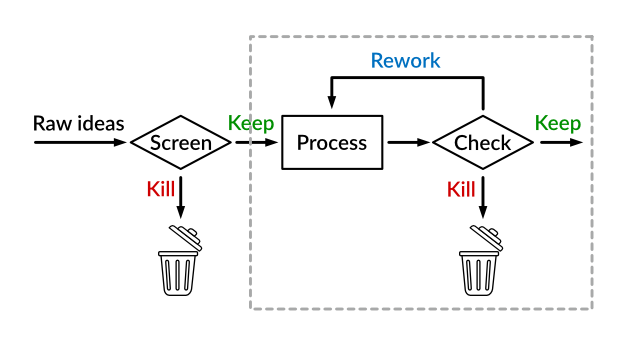
Der Innovationsprozess besteht aus einem Ideenteil und dem darauffolgenden Implementierungsteil. Der Ideenteil beginnt mit dem Input von rohen Ideen und endet mit ausgearbeiteten Empfehlungen für das Management. Genehmigte Empfehlungen gehen dann über in die Implementierung. Der Ideenprozess sollte aus mehreren Phasen bestehen, in denen die Ideen weiter ausgebaut und bewertet werden. Ideen, die die Phasenkriterien nicht erfüllen, werden entweder überarbeitet oder verworfen.
Mit einem gut funktionierenden Innovationsprozess sichert ein Unternehmen einen zuverlässigen Strom an Ideen für Produkterweiterungen, neue Produkte und Geschäftsmodelle für sich.
Beispielprojekt Innovationsprozess einrichten
Ein mittelständisches Unternehmen der Umweltbranche wollte sein Portfoiio erweitern und seinen Marktanteil vergrößern. Die Gewinnung und Prüfung von Ideen war zu dem Zeitpunkt unstrukturiert und dadurch wenig ergiebig. Das Unternehmen wollte von Gelegenheiten aufgrund von Neuerungen in der Gesetzgebung und der bevorstehenden Internationalisierung des Marktes profitieren. Es hatte aber kein strukturiertes Vorgehen, um diese Gelegenheiten zu erfassen und zu bewerten.
Wir haben in Zusammenarbeit mit der Geschäftsleitung und dem Innovationsmanager einen Entwurf für einen dreistufigen Ideenprozess entwickelt. Die Hauptaufgabe für uns bestand darin, die richtigen Bearbeitungsaufgaben und Prüfkriterien für jede Stufe zu identifizieren. Dabei haben wir uns an das RWW-Modell für die Bewertung von Produktideen orientiert. Dieses Modell besteht aus den drei Fragen Ist es echt?Lohnt es sich? und Können wir gewinnen?
Wir haben die drei Prozessstufen in der Projektmanagement-Software monday implementiert, um die Arbeitsbelastung für den Innovationsmanager (der zugleich Prozessverantwortlicher war) zu minimieren.
Zum Projekt gehörte auch ein Workshop, um das neue System im Unternehmen vorzustellen und um erste Inputs für den Prozess zu generieren. An diesem Workshop nahmen neben der Geschäftsleitung alle Bereichsleiter teil.
Vom ersten Kennenlerngespräch bis zum Auftaktworkshop und zur Übergabe der Software-Implementierung dauerte das Projekt ungefähr sieben Monate.
Product Market Fit (PMF) bedeutet, dass ein Produkt zu den Bedürfnissen seines Marktes passt. Er ist der ‚heilige Gral‘ für Gründer, denn mit dem Erreichen des Fits steigen die Erfolgschancen für ihr Startup massiv. Allerdings ist er auch sehr anspruchsvoll. Andrew Chen hat einmal geschrieben, Startups need to get to Product Market Fit, or die trying. Most die trying. In diesem Beitrag erklären wir, was Product Market Fit ist, und wir geben ein paar Tipps für Gründer.
Was Product Market Fit ist
Eric Ries, Autor des Buchs The Lean Startup, definiert PMF so: The term product/market fit describes the moment when a startup finally finds a widespread set of customers that resonate with its product. In unseren Gesprächen mit Gründern erklären wir, Product-Market Fit bedeutet, euer Produkt ist so weit gediehen, dass ein große Zielgruppe es kaufen will. Ihr dürft dann Investoren suchen und mit der Skalierung eures Unternehmens beginnen.
Product Market Fit ist das Resultat einer langen Experimentierphase, in der Startups kontinuierlich Feedback von Testnutzern und Kunden sammeln, mit dem sie ihr Angebot optimieren. Das Ergebnis ist ein Produkt, das den Bedürfnissen des Marktes entspricht und auf eine große Nachfrage stößt.
Die Messlatte für PMF is hoch: Michael Seibel von Y Combinator schreibt: If you are not drowning in demand, you don’t have Product-Market Fit. Drei Voraussetzungen müssen erfüllt sein, damit die Gründer ‚in der Nachfrage untergehen‘:
Product: Das Produkt liefert einzigartige Kundenvorteile.
Market: Es gibt eine große Zielgruppe mit einem starken Bedürfnis nach einer besseren Lösung.
Fit: Es gibt keine ernsthaften Gründe, die dem Kauf oder der Nutzung des Produktes entgegenstehen.
Ist eine dieser Bedingungen nicht erfüllt, so verkauft sich das Produkt schleppend (oder möglicherweise gar nicht), und die Gründer finden keine Investoren, um die Wachstumsphase zu finanzieren. Die zweite Voraussetzung (Market) gehört zum Problem-Solution Fit und sollte schon vor dem Eintritt in die PMF-Phase bestätigt sein.
Woran man Product Market Fit erkennt
Ein weit verbreiteter Test für PMF stammt von Sean Ellis: Kunden werden gefragt, Wie würden Sie sich fühlen, wenn Sie unser Produkt nicht mehr benutzen dürften? Wenn mindestens 40% der Kunden erklären, sie wären dann sehr enttäuscht, so darf man auf einen guten Product-Market Fit schließen.
Eine ähnliche Möglichkeit besteht darin, den Net Promoter Score (NPS) zu ermitteln. Der NPS vergleicht den Anteil der Kunden, die erklären, sie würden das Produkt an andere weiterempfehlen mit dem Anteil der Nichtempfehler. Ein Ergebnis von 60% oder höher gilt als sehr gut und als Indikator für einen guten Fit. Um einen NPS von 60% zu erreichen, müssen zum Beispiel 70% aller Kunden das Produkt weiterempfehlen und höchstens 10% nicht.
Wenn die Nutzung des Produktes messbar ist (zum Beispiel wenn sie nach Pay-per-use abgerechnet wird), deutet ein Steigen der Nutzungsdauer oder -häufigkeit auf einen besser werdenden Fit. Bei Produkten im Abonnement-Modell ist die Quote der Kunden, die ihr Abonnement verlängern, auch ein Indikator für die Güte des PMF.
Faktoren, die den Fit verhindern
Es gibt viele Faktoren, die einen guten Product Market Fit verhindern können. Hier sind unsere Top-5:
Der Einsatz des Produktes hat einen unerwünschten Nebeneffekt.
Die Kosten für den Wechsel zum neuen Produkt (die sogenannten Switching Costs) sind zu hoch.
Um das Produkt zu benutzen, muss der Kunde etwas tun, was er nicht tun möchte.
Das Produkt passt nicht zu den vorhandenen Rahmenbedingungen.
Die Nutzung des Produktes ist kompliziert oder umständlich.
Hinweise, dass der Fit noch nicht erreicht ist
Es ist schwierig, das Erreichen von Product Market Fit nachzuweisen; es ist aber leicht, zu erkennen, dass er noch nicht erreicht ist. Hier sind sieben typische Warnzeichen:
Der Umsatz wächst nur schleppend.
Viele Kunden kehren nie zurück, um ein zweites Mal zu kaufen bzw. um ihr Abonnement zu verlängern.
Kunden hören bald auf, das Produkt zu benutzen.
Die Kunden empfehlen das Produkt nicht weiter.
Ein nennenswerter Anstieg in der Kundenzahl ist nur mit Hilfe einer kurzfristigen Rabattaktion oder einer anderen künstlichen Maßnahme zu erreichen.
Die Kunden sind vielleicht zufrieden mit dem Produkt, aber sie sind nicht wirklich begeistert davon.
Interessenten brauchen sehr lange, um sich zum Kauf zu entscheiden.
Praxistipp
Es gibt eine große Gefahr für Gründer, vor der wir immer wieder warnen. Es geht um den irrtümlichen Glauben, dass sie den Fit bereits erreicht hätten. Es genügt aber nicht, dass erste Umsätze mit dem Produkt gemacht werden. Vielmehr muss das Startup regelmäßig neue Kunden akquirieren zu einem Preis (Customer Acquisition Cost), der deutlich unter deren Gewinnpotenzial (Customer Lifetime Value) liegt. Erst dann sind große Investitionen – zum Beispiel in Marketing und Personal – gerechtfertigt.
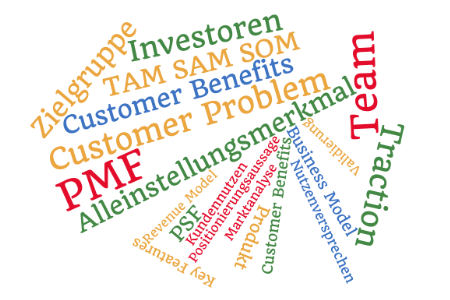
Die Beiträge in dieser Kategorie richten sich an Startup-Gründer während der Konzeptions- und Planungsphase ihres Unternehmens. Noch bevor sie damit beginnen, ein Produkt zu entwickeln, müssen Gründer einige Aufgaben erledigen. Dazu gehören: ein lohnenswertes Kundenproblem aufdecken, die entsprechende Zielgruppe charakterisieren, ein Lösungskonzept entwickeln und ein passendes Geschäftsmodell wählen. Im zweiten Schritt werden unter anderem ein Nutzenversprechen und eine Positionierungsaussage für das Produkt formuliert, und es wird eine Marktanalyse durchgeführt.
Wir haben diese Inhalte für unsere Startup-Lehrveranstaltungen an der Universität Magdeburg und für das Gründer-Coaching entwickelt – zum Beispiel für die Founders Foundation in Bielefeld.
Werkzeuge für Startup-Gründer
Problem Solution Fit ist der erste Meilenstein im Gründungsprojekt. Hier prüfen die Gründer, ob ihre Geschäftsidee prinzipiell Erfolg haben kann.
Beim Product Market Fit stellen die Gründer sicher, dass ihr Produkt für den Markt attraktiv sein wird.
Mit einer Positionierungsaussage beschreiben die Gründer ihre Kunden und warum diese ihr Produkt kaufen soll.
Ein Nutzenversprechen erklärt in wenigen Worten die besonderen Vorteile eines Produktes.
Eine Nordsternmetrik ist eine Kennzahl, um das Wachstum eines Startups zu messen und zu lenken.
Das TAM-SAM-SOM-Modell erklärt Geldgebern das Marktpotenzial eines Produktes.
Our second post about generating ideas with ChatGPT uses the Analogy method (Analogietechnik). The analogy technique is a powerful and flexible method for generating ideas, which forms a cornerstone of our idea workshops. It has the advantages of being applicable in a wide range of circumstances and of being easily understood and accepted by workshop participants.
The Analogy method
The Analogy method uses analogies of the ideation task as inspiration for ideas. The rationale for this approach is that by choosing inspirations that are related to the task at hand will improve the relevance of the ideas that are generated. For example, if we need costume ideas for a fancy dress party, a good source of ideas would be other events where costumes are worn, such as in the theatre or the movies.
Using Analogies with ChatGPT
It is easy to obtain analogies with ChatGPT (assuming we interested in a field that ChatGPT knows something about). We can then use these as inspiration for ideas like we did with the random inspirations.
We have the following ideation task:
How can we make our university more attractive?
Here are some sample conversations. I have reworded and adapted them for easier reading. My inputs are shown in blue, and ChatGPT’s responses are shown in red.
What are some typical and important attributes of a university?
Academic Excellence
Research and Innovation
Expertise
Library
Accreditation
Expertise
What organizations or institutions have leading experts?
NASA
What ideas would NASA suggest to improve the attractiveness of a university?
Create internships for students with space agencies such as NASA or ESA
Create opportunities for students to access space telescopes and observatories
Library
What organizations have a library?
Museums
What ideas would a museum suggest to improve the attractiveness of a university?
Showcases where students can exhibit their creations
Excellence
Who is excellent at what they do?
Yo Yo Ma
What ideas would Yo Yo Ma suggest for improving the attractiveness of a university?
Offer music therapy programs to reduce stress and facilitate relaxation
Accreditation
Who or what needs accreditation or a license to perform their task?
A pilot
What ideas would a pilot suggest for improving the attractiveness of a university?
Flight Training Camps for students
Innovation
What organizations are particularly well known for their innovation?
IBM Watson
What ideas would IBM Watson suggest for improving the attractiveness of a university?
Virtual Academic Advisingpowered by AI chatbots
Practical tips
In each case, ChatGPT produced 10 to 15 responses to each analogy question; I then selected just one each time for the idea generation.
The ideas vary considerably in their ease of implementation, cost and effectiveness. However, that is true of any idea generation method, and the large number of analogies that ChatGPT can instantaneously generate suggest that it has significant potential as a creativity support tool.
This is the second article in a series about using ChatGPT to generate ideas. The first article discussed the random input technique.
Startups müssen schnell wachsen, um sich im Markt zu etablieren und den Ansprüchen ihrer Investoren gerecht zu werden. Es gibt mehrere Metriken, um Wachstum zu messen, zum Beispiel der Umsatz oder die Zahl der Nutzer. Die Gründer können aber auch eine sogenannte Nordsternmetrik wählen – eine Größe, die einige solche Kennzahlen umfasst. Ihre Aufgabe ist, auf den Punkt zu bringen, was das Startup letztendlich verbessern muss, um zu wachsen. In diesem Artikel erklären wir die Nordsternmetrik und geben ein paar Beobachtungen und Erfahrungswerte aus der Praxis weiter.
Was ist eine Nordsternmetrik?
In der Antike wurde der Nordstern Polaris in der Seefahrt für die Navigation genutzt, weil er immer im Norden steht. Analog dazu wird eine Nordsternmetrik (North Star Metric) benutzt, um die Zielrichtung für ein Startup anzuzeigen. Es ist Aufgabe der Gründer, diese Kennzahl zu erhöhen. Wenn das gelingt, folgen andere, konventionelle Kennzahlen automatisch nach. Es gibt viele Ressourcen im Internet, die die North Star Metric beschreiben, zum Beispiel bei Amplitude und bei Rocketsource.
Was ist eine gute Nordsternmetrik?
Die Aufgabe jedes Produktes besteht darin, einen Kundennutzen zu erbringen. Daraus folgt: je größer der Kundennutzen eines Produktes, desto erfolgreicher ist es. Eine gute Nordsternmetrik misst den gesamten Kundennutzen, den ein Produkt leistet. Jede Maßnahme, die die Nordsternmetrik verbessert, stärkt das Produkt.
Hier sind drei (von uns erfundene) Beispiele für Nordsternmetriken von Unternehmen, als sie in der Startup-Phase waren:
Airbnb. Der Kundennutzen von Airbnb tritt sowohl für Reisende als auch für Vermieter dann ein, wenn eine Vermietung zustande kommt. Darum könnte die Nordsternmetrik von Airbnb die Anzahl gebuchter Übernachtungen pro Monat sein.
Quora. Der Kundennutzen von Quora besteht darin, dass die Nutzer untereinander ihr Wissen teilen. Aus diesem Grund wäre eine plausible Nordsternmetrik die Anzahl beantworteter Fragen pro Woche.
Medium. Medium ist eine Internet-Plattform, wo Autoren und Leser Artikel und Ideen teilen. Da bietet sich die gesamte Lesezeit aller Nutzer innerhalb einer Woche als Nordsternmetrik an.
Aus der Metrik Ziele ableiten
Eine Nordsternmetrik kann nicht direkt beeinflusst werden. Um praktisch nützlich zu sein, leitet man daraus Teilmetriken ab, für die man konkrete Verbesserungsmaßnahmen entwickeln kann.
Die Gründer eines E-Commerce-Startups könnten zum Beispiel den monatlichen Gesamtwert aller verkauften Artikel als Nordsternmetrik wählen. Es gibt viele Teilmetriken, die dazu einen Beitrag leisten, zum Beispiel:
Die wöchentliche Anzahl neuer Shop-Besucher,
Der Anteil der neuen Besucher, die eine eine Bestellung auslösen,
Der mittlere Wert eines Warenkorbs,
Der Anteil der Besucher, die abspringen, ohne etwas zu kaufen.
Für diese Teilmetriken können die Gründer Ziele festlegen und Maßnahmen planen, um sie zu erreichen. Sie könnten eine Anzeige für die Entwicklung der Metrik im Büro installieren, sodass alle im Unternehmen ein klares Bild davon haben, was sie gemeinsam erreichen wollen und wie ihre eigene Aufgabe im Unternehmen dazu beiträgt.
Was eine Nordsternmetrik nicht ist
Die Nordsternmetrik wird gelegentlich missverstanden (und missbraucht).
Bei Startup-Gründern gibt es die Gefahr, eine sogenannte Eitelkeitsmetrik zu wählen. Dies sind Kennzahlen, die zwar gut aussehen können, aber kein zuverlässiges Maß für die tatsächliche Attraktivität eines Produktes darstellen. Typische Beispiele sind bei einer mobilen App die Zahl Downloads oder die Zahl neuer Nutzer. Ein Download allein sagt nichts darüber aus, ob das Produkt einen Nutzen erbringt und daher Geld verdienen kann, denn ein neuer Nutzer, der von der App enttäuscht ist, wird sie nach kurzer Zeit von seinem Gerät wieder löschen.
Die zweite Gefahr ist die Verwendung einer konventionellen Metrik wie Umsatzwachstum oder Marktanteil. Dies sind Werte, die Gesellschafter und Aktionäre interessieren, aber sie sind wenig hilfreich als Orientierung im Alltag für die Gründer und ihre Mitarbeiter. Diese Gefahr ist noch größer bei etablierten Unternehmen, für die Umsatzwachstum seit Jahren als alleinige Kennzahl bekannt ist. In beiden Fällen ist es wichtig zu verstehen, dass die Nordsternmetrik eine praktische Hilfe für die Mitarbeiter ist, die im Erfolgsfall automatisch zum gewünschten Umsatzwachstum, Marktanteil usw. führt.
Erfahrungen aus der Praxis
Unser erster Schritt in einem Workshop zur Festlegung einer Nordsternmetrik besteht darin, messbare Ereignisse oder Vorgänge zu identifizieren, die belegen, dass das Produkt einen Kundennutzen erbracht hat. Dazu stellen wir Fragen wie diese:
Durch welche Aktionen oder bei welchen Ereignissen wird die Nutzung Ihres Produktes eingeleitet oder abgeschlossen? Beispiel: Zwei Nutzer schließen einen Vertrag.
Durch welche Aktivitäten entsteht der Nutzen Ihres Produktes? Beispiel: Die Turbine läuft.
Woran erkennen Sie, dass Ihr Produkt tatsächlich einen Nutzen gestiftet hat? Beispiel: Ein Nutzer kennzeichnet ein Projekt als abgeschlossen.
Diese Aktivitäten und Ereignisse müssen natürlich leicht messbar sein.
Im zweiten Schritt helfen wir den Teilnehmern, ihre Antworten zu priorisieren und zu optimieren. Dabei hilft eine Checkliste mit Qualitätskriterien.
Diese Workshops können lebhafte Diskussionen unter den Teilnehmern erzeugen, worin der eigentliche Kundennutzen ihres Produktes liegt und woran man ihn erkennen kann. Das kann zu neuen Erkenntnissen führen und sogar zu spontanen Ideen für Produktverbesserungen.
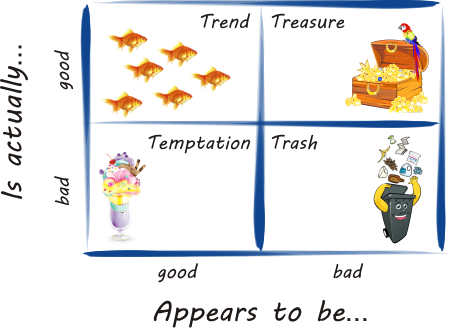
In an earlier post (in German), we presented our „4T“ model of idea quality. This model is useful in explaining potential evaluation errors to clients that can cost them either wasted time and money or a missed opportunity. The model distinguishes four types of idea:
Trash: The idea appears to be bad and actually is bad.
Temptation: The idea appears to be good, but is, in fact, bad.
Trend: The idea both appears to be good, and actually is good.
Treasure: The idea is, in fact, good, but appears to be bad.
Trend ideas and Trash ideas do not present a problem: they can be safely pursued and ignored, respectively. Temptations can be avoided using a set of reliable evaluation criteria. One example are the Is it real? questions by George Day (Our article in German).
The tricky issue is the question Trash or Treasure? As Peter Thiel famously pointed out in a lecture about startups, the very best ideas appear to be bad. (If they had appeared to be good, others would already have implemented them.) A Treasure idea can lead to a unique product that enjoys a monopoly in its market.
Bad and good ideas
An idea is good, if it brings a large reward. For a product or service, this typically means an increase in sales and/or market share. To achieve this, the product offers superior customer value and is easy for customers to adopt.
Ideas seem bad, because they conflict with the status quo – they appear to be difficult or even impossible to implement. 15 years ago, the idea of Airbnb seemed ridiculous to many (including myself!); after all, who wants to stay the night in a stranger’s apartment or let a complete stranger use their apartment? For this reason, teams from established companies usually want to reject ideas of this type. We have seen this happen many times in our workshops.
The Trash-or-Treasure question
However, there is a simple question that can protect you from rejecting Treasure:
How would we feel if we learned that a competitor had just implemented this idea?
If this question generates admiration, frustration or envy, then the idea is Treasure; the imaginary competitor has managed to overcome the difficulties and is now reaping the benefits.
The „Trash or Treasure“ question occupies a permanent place in our facilitator’s toolbox, and we never hesitate to get it out, if we feel that the group is about to reject a Treasure.
Die Risiken, die innovative Produkte mit sich bringen, sind hoch. In einem Artikel im Harvard Business Review hat George Day drei Prüffragen für neue Produktideen vorgestellt, um das Risiko eines Scheiterns zu reduzieren:
Is it real? (Ist es echt?)
Can we win? (Können wir gewinnen?)
Is it worth doing? (Lohnt es sich?)
Eine Gefahr, die sowohl einem Startup als auch einem etablierten Unternehmen droht, ist, eine interessante Idee durch eine rosarote Brille zu sehen und dadurch mögliche Probleme und Hindernisse zu übersehen. Diese drei Fragen können helfen, denn durch die Beschäftigung mit den Fragen deckt ungeprüfte Annahmen und Wissenslücken auf, die den Erfolg des Produktes gefährden könnten. Das Vorgehen wird von namhaften Technologieunternehmen wie 3M und Novartis eingesetzt, um vielversprechende Produktideen zu identifizieren und zu verfeinern.
Die erste Frage, die geklärt werden muss, lautet Is it real? (Ist es echt?) Damit soll geprüft werden, ob die Idee durch belegbare Fakten gestützt wird und ob die Basisvoraussetzungen für ihren Erfolg gegeben sind. Dafür wird die Frage in verschiedene Aspekte aufgeteilt.
Neun Beispiele für Ist es echt?-Kriterien
Hier sind neun Kriterien, die unterschiedliche Perspektiven auf die Frage Ist es echt? liefern:
Das Produktkonzept ist klar. Es muss klar sein, wie das Produkt aussieht, was das Produkt macht, und an welche Zielgruppe es sich richtet. Sonst ist es nicht möglich, eine zuverlässige Bewertung vorzunehmen.
Das Produkt bedient ein vorhandenes Kundenbedürfnis. Besonders Startup-Produkte scheitern, weil es keine ausreichende Nachfrage danach gibt. Das Bedürfnis muss auch stark genug sein, um den Kauf des Produktes zu rechtfertigen.
Es gibt keine Barrieren zum Kauf des Produktes. Besonders bei Unternehmenskunden könnte es technische, organisatorische oder innenpolitische Hindernisse geben.
Potenzielle Kunden werden das Produkt kaufen. Auch wenn das Produkt die versprochene Leistung erbring,t kann ein Produkt zu Ladenhüter werden. Eine häufige Ursache ist, dass das Kundenbedürfnis nicht die ausreichende Priorität hat.
Das Produkt wird die Kundenerwartungen (über-)erfüllen. Das Produkt muss (mindestens!) den Nutzen erbringen, den seine Nutzer von ihm erwarten.
Das Marktpotenzial ist ausreichend groß. Die Marktanalyse gehört eigentlich zur Frage 3 Is it worth doing? (Lohnt es sich?) Doch schon zum Anfang muss eine grobe Schätzung ein ausreichendes Marktpotenzial ergeben.
Wir können das Produkt realisieren. Die Fähigkeiten und Ressourcen sind vorhanden, um das Produkt effizient zu realisieren (oder sie können leicht beschafft werden).
Das Produkt erfüllt alle relevanten Vorschriften. Das Produkt verstößt gegen keine Umwelt-, Arbeits-, Sicherheits- oder sonstige Vorschriften.
Das Produkt passt zu unserer Strategie. Der Aufwand und die Risiken eines neuen Produktes nehmen zu, wenn es nicht zur bisherigen Unternehmensstrategie, Marke oder Zielgruppe passt.
Anwendung für etablierte Unternehmen
Bei Unternehmen, die Innovation proaktiv betreiben, befinden sich viele Ideen gleichzeitig in der Pipeline. Darum haben sie einen strukturierten Innovationsprozess, in dem diese Ideen erfasst, bearbeitet und vorangetrieben werden. Dieser Prozess kann mit einer guten Projektmanagement-Software verwaltet werden; Unserer Meinung nach eignet sich Monday für diesen Zweck.
Der Ideenprozess wird in mehrere Stufen unterteilt; in jeder Stufe werden Ideen verfeinert und präzisiert und anschließend bewertet. Die erfolgreichen Ideen kommen in die nächste Phase. Die Frage Ist es echt? eignet sich als erste Prozessstufe; sie enthält (nur) Kriterien, die prüfen, ob das Produkt – zumindest theoretisch – ein Erfolg werden kann. (Die anspruchsvolleren und präziseren Kriterien kommen in den späteren Phasen.)
Anwendung für Startups
Der häufigste Grund, warum Startups scheitern, ist, dass sie Lösungen bauen, für die es keine Probleme gibt. Das geschieht, weil die Gründer sofort mit der Entwicklung ihres Produktes beginnen, ohne sich vorher zu vergewissern, das ihr Produkt zumindest prinzipiell eine Erfolgschance hat.
Darum sollte die erste Phase im Leben eines Startups die Problem-Solution Fit-Phase sein. Diese entspricht inhaltlich weitgehend der Ist es echt?-Frage. Erst wenn diese Grundlagen sicher sind, sollten die Gründer dazu übergehen, ihr Produkt zu entwerfen und zu testen.
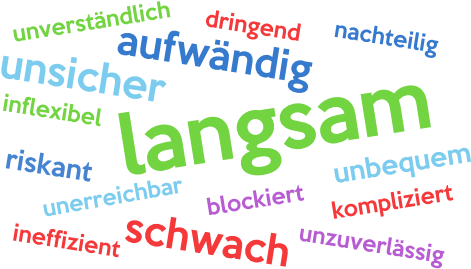
Wir werden oft gebeten, Unternehmen bei der Entwicklung neuer Dienstleistungsideen zu unterstützen. Um das effektiv zu tun, ist es wichtig, die Gründe zu kennen, warum Dienstleistungen gekauft werden, denn sie liefern Inspiration für Ideen, die zugleich einen Kundennutzen enthalten. Die Gewinnung von Ideen für neue oder erweiterte Dienstleistungen ist ein kleiner, aber wichtiger Teil des Service Engineering, wo unser Ideen-Workshop einen Teil eines umfangreicheren Projektes bildet.
Wir haben eine Liste zusammengestellt mit den Top-15 Gründen, warum ein Unternehmen eine Dienstleistung kauft. Diese Liste ist im Laufe der Jahre aus den Fünf Prüfkriterien für Dienstleistungsideen und der PERFECT-Checkliste von Kundennutzen entstanden. Wir haben sie hier in Form von Selbstaussagen eines Dienstleistungskunden formuliert. Diese Selbstaussagen werden im Gespräch manchmal explizit, aber häufiger nur implizit geäußert.
Das ist für uns schwer zugänglich!
Manchmal ist etwas, was ein Unternehmen braucht, außer Reichweite. Das kann zum Beispiel an der geografischen Entfernung liegen, an einer Sprachbarriere oder einer rechtlichen Vorschrift. In solchen Situationen wird ein Dienstleister mit den entsprechenden Möglichkeiten beauftragt.
Das ist ineffizient!
Unternehmen können bestimmte Aufgaben zwar selbst lösen, aber das Ergebnis rechtfertigt ihren Aufwand nicht. Ein spezialisierter Dienstleister, der über die entsprechenden Fähigkeiten oder Werkzeuge verfügt, kann die Aufgabe besser und kostengünstiger erledigen.
Das ist zu riskant!
Ein externer Spezialist kann für seine Kunden ein Risiko reduzieren oder beseitigen. Das kann beispielsweise ein finanzielles oder ein rechtliches Risiko sein oder auch das Risiko, einen schwerwiegenden Fehler zu machen.
Das ist zu wenig flexibel!
Manchmal braucht ein Unternehmen mehr Flexibilität, als seine aktuelle Lösung ihm bietet. Ein typisches Beispiel sind Lastschwankungen; es wäre zu teuer, Mitarbeiter oder Anlagen zu halten, wenn sie nur sporadisch benötigt werden. In solchen Situationen ist es effizienter, im Bedarfsfall einen Dienstleister zu beauftragen.
Da muss schnell was passieren!
Bei dringenden Problemen bleibt einem Unternehmen manchmal keine Alternative, als einen Dienstleister zu beauftragen, um die Situation zu bereinigen. Das kann daran liegen, dass das Unternehmen die Kapazität oder die Fähigkeit nicht besitzt, um das Problem zu lösen, oder dass es seine Mitarbeiter nicht von ihrem Stammtätigkeiten abziehen möchte, um sich um das Problem zu kümmern.
Wir kommen nicht weiter!
Wenn ein Unternehmen ein Projekt nicht fortsetzen kann, weil ihm eine bestimmte Ressource oder Information fehlt, kann ein Dienstleister schnell Abhilfe schaffen. Ein Beispiel ist eine Zusage des Staates, für die aber ein aufwändiger Antrag erforderlich ist.
Das hat für uns einen Nachteil!
Manchmal verfügt ein Unternehmen über eine Lösung, die allein für sich genommen zufriedenstellend ist, aber ein neues Problem mit sich bringt oder einen unerwünschten Nebeneffekt hat. Ein Dienstleister, der eine problemfreie Lösung anbieten kann, hat hier eine gute Gelegenheit.
Das ist schwer zu verstehen!
Wenn es zu teuer wäre oder zu lang dauern würde, einen komplexen Sachverhalt zu durchdringen, kann ein externer Spezialist schneller und billiger Klarheit schaffen. Das kann den zusätzlichen Effekt haben, das Risiko einer Fehlentscheidung zu verringern.
Das ist zu kompliziert!
Ganz ähnlich verhält es sich mit Komplexität; eine komplizierte Situation erfolgreich zu meistern könnte so viel Aufmerksamkeit von leitenden Arbeitskräften kosten, dass es insgesamt effektiver ist, einen externen Experten zu holen.
Das ist unbequem!
Unbequeme Projekte können Reibung verursachen. Um das Betriebsklima zu schonen oder wichtige Mitarbeiter nicht zu verstimmen kann die Geschäftsführung beschließen, die unbequeme Aufgabe nach außen zu vergeben.
Das ist unzuverlässig!
Wenn eine bestehende Lösung eine wichtige Funktion hat aber nicht zuverlässig funktioniert, kann sich ein Unternehmen nach einer zuverlässigeren Lösung umsehen.
Die Leistung ist zu schwach!
Ein Unternehmen kann mit der Leistung einer bestehenden Lösung unzufrieden werden. Das ist zum Beispiel der Fall, wenn es wächst oder seine Qualitätsansprüche steigen. Das ist dann für einen Lieferanten eine Gelegenheit, ein leistungsfähigeres Produkt zu entwickeln (oder das eigene Produkt dringend zu verbessern!)
Das ist zu unsicher!
Wenn eine Aktivität wichtig, aber ihr Erfolg ungewiss ist, kann eine entsprechende externe Unterstützung für mehr Gewissheit sorgen.
Das geht zu langsam!
Wenn ein Flaschenhals das Wachstum bremst oder die Profitabilität beeinträchtigt, muss ein Unternehmen Abhilfe schaffen. Ein spezialisierter Dienstleister kann zeigen, wie der Flaschenhals beseitigt werden kann, oder er kann sogar selbst die Problemstelle im Prozess übernehmen.
Das ist zu aufwändig!
Wenn eine Aufgabe so viele Ressourcen verbraucht, dass andere, wichtige Aufgaben zu kurz kommen, muss eine effizientere Lösung gefunden werden. Spezialisierte Service-Anbieter können über Kenntnisse oder Techniken verfügen, die die gleiche Aufgabe mit wesentlich geringerem Aufwand erledigen.
Anwendung im Ideenworkshop
In einem Workshop zur Generierung von Dienstleistungsideen beginnen wir, indem unsere Teilnehmer die spezifische Situation oder Aufgabe ihrer Kunden in Erinnerung rufen, in der die Dienstleistung zum Einsatz kommt bzw. kommen soll. Dazu gehören insbesondere alle Sorgen, Probleme und Ärgernisse, die diese Kunden derzeit plagen. Dann stellen wir den Teilnehmern Fragen, zum Beispiel:
Was geht Ihren Kunden zu langsam?
Welcher Aspekt dieser Situation ist für Ihre Kunden zu kompliziert?
Was würden Ihre Kunden gern tun oder erreichen, können es aber derzeit nicht?
Wo haben Ihre Kunden mehr Aufwand, als es ihnen eigentlich recht ist?
Die Antworten auf diese Fragen können Inspiration für neue Dienstleistungen oder für Verbesserungen von bereits existierenden Angeboten liefern. Voraussetzung für den Erfolg ist natürlich, dass unser Auftraggeber seine eigenen Kunden und deren Situation gut kennt!
Lieber Besucher, wir benutzen Cookies, um für Sie das beste Erlebnis auf unseren Seiten zu ermöglichen. Wir nehmen an, dass Sie damit einverstanden sind, wenn Sie weiter auf unseren Seiten surfen. Viel Erfolg!Ok